
01 / The Beginnings
Making the Internet Feel Like a Place
Traveler emerged from EnterTV, the company that became OnLive Technologies. Douglas Crockford’s April 2001 account of Communities.com’s intellectual property identifies Traveler as EnterTV’s 3D social world, built around talking avatar heads. This was an attempt to give online conversation a location and a visible speaker. [3]
Lead architect Steve DiPaola’s early Stanford talk describes the design problem as both technical and social. Architecture, facial animation, navigation, and sound had to work together. The team drew on familiar human behavior: looking toward another person, recognizing an expression, and understanding that a voice has a position in a room. [5]
In August 1996, WIRED described Traveler as a stand-alone VRML browser for a Pentium PC, with microphone input and simultaneous, spatialized conversation. “Browser” here meant downloadable software for exploring virtual worlds; it did not mean a modern website running directly in a browser tab. [1]
By September 24, the San Francisco Chronicle reported that Traveler 1.0 was available free, supported up to 15 simultaneous speakers, and offered six locations. These included an MTV beach resort, a sports bar, and a world tied to The Frighteners. The report also described adjustable avatars, expressions, and profiles. [2]
02 / Milestones
The Timeline
The Design Takes Shape
A Stanford archive records DiPaola presenting the beta system and its social design. The page’s date labels conflict, so it should not be used to establish an exact launch day. [5]
Traveler Reaches the Public
WIRED covers the voice-enabled software in August; the Chronicle reports the available 1.0 release in September. [1] [2]
Version 2.02
Brian “Oz” Thomasson’s later community history credits Dave Collins’s engineering team with the 2.02 release and its VRML 1.0 work. [4]
A New Corporate Home
Traveler’s history becomes part of Communities.com through acquisitions and reorganization involving OnLive, The Palace, and Electric Communities. [3] [4]
A Community Lifeline
Oz’s Avatars 2001 account describes Bruce Damer’s intervention to keep the platform available after Communities.com closed. [4]
The Designers Reflect
DiPaola and Collins publish their design analysis in the SIGGRAPH Educators Program, examining how voice and avatars create social presence. [6]
A World Remembered in Images
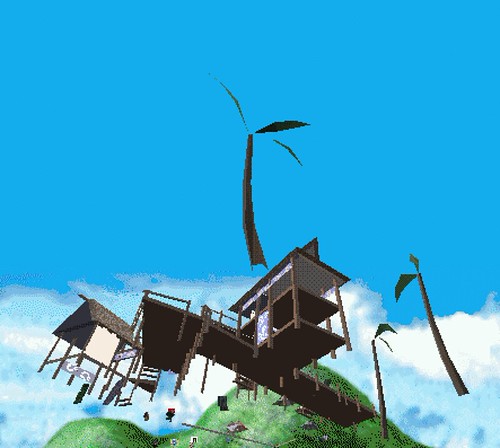
Kyra Ocean’s Tikkiland capture preserves a view of the original software years after its debut. [9]
Browser Relaunch
Traveler’s Back. The browser edition is scheduled to launch Friday, October 2, 2026 at 6 p.m. Eastern Time.
03 / Inside the World
Voice, Faces, and the Space Between
Traveler’s first-person world allowed movement in three dimensions. A person’s voice belonged to their avatar: its apparent direction and loudness changed with the listener’s position. Facial animation connected that voice to a visible face. DiPaola and Collins describe a deliberate emphasis on communication, rather than visual complexity for its own sake. [6]
The familiar floating heads were three-dimensional models, not simply portraits pasted into the scene. Their animation combined blinking, speech movement, and emotion. This made a small visual vocabulary expressive: a face could communicate who was speaking and suggest how they felt without a detailed full-body character. [6]
Oz’s history credits Stasia McGehee with much of the expressive avatar artwork. It also credits Jm Valera’s work on the Destinations Page, which showed who was online and the server and space they occupied. Finding people mattered as much as finding scenery. [4]
04 / A Place to Belong
What People Did Once They Arrived
Bruce Damer’s Avatars! archive records Traveler as a setting for playful invention and performance. Users devised avatar sports; poets gathered in a carousel world. His account also places a VOCE group chant, led by Phil Harrington and Paul Godwin, at SIGGRAPH 1996 in New Orleans. Voices crossed between an in-person audience and the virtual gathering. [7]
Utopia appears in that same archive in a July 1996 family anecdote. These personal recollections are useful evidence of how early worlds entered everyday life, although they do not establish when every surviving world file was created. A familiar name can persist while a space is edited, relocated, or rebuilt. [7]
Researchers also studied what happened between avatars. Phillip Jeffrey and Gloria Mark’s 1998 study observed Active Worlds and OnLive Traveler, finding that personal distance, crowding, and group boundaries affected behavior. People signaled privacy through where they positioned themselves and reacted when others intruded. The study treats virtual space as social space, not merely a rendered background. [8]
A contemporary SIGCHI conference report describes Barbara Becker comparing social conventions in Traveler, Active Worlds, and LambdaMOO. Different environments encouraged different styles of interaction. Traveler belonged to a wider period of experimentation in which researchers asked how an interface could shape a community, rather than merely carry its messages. [10]
Those accounts suggest why the visual world mattered. Distance could be a conversational choice; turning toward someone could be a social gesture. The scene gave people a shared frame of reference. This is an interpretation of the research, rather than a claim that every visitor experienced Traveler in the same way. [8] [10]
05 / Keeping the Worlds Alive
Beyond the Original Company
Traveler’s corporate history was less durable than its social appeal. Crockford’s 2001 memorandum records Electric Communities acquiring OnLive and The Palace before becoming Communities.com. It distinguishes Traveler from Talker, the nonvisual conferencing application, and from other products within the company. Shared ownership did not mean these were all the same virtual-world system. [3]
In the Avatars 2001 archive, Oz describes Bruce Damer and the historical company DigitalSpace acquiring rights and maintaining essential community resources. The event page links OzGate, Cadre d’Image, and World Wide Party. Its account is both a history and a participant’s expression of relief that the community could continue. [4]
Reading the Record Carefully
The contemporary press establishes public availability in 1996. The Stanford beta abstract has conflicting date labels. Oz’s 2001 account provides valuable community history, while Crockford supplies a separate company perspective. Historical rights statements alone do not establish the present licensing of every avatar, texture, or world file. [1] [3] [4] [5]
Seen together, the record tells a story about a durable idea: a virtual world can be a place for ordinary conversation. The voices and relationships give meaning to the geometry. Preserving Traveler therefore involves more than retaining a program, it also means keeping the artwork, documentation, and community memories understandable to people arriving years later.
06 / The Source Archive
References & Images
This history draws on contemporary journalism, original design research, and participant archives. Retrospective accounts are identified as such. Sources were reviewed September 9, 2026; dates below are publication or capture dates, not search-engine crawl dates.
- Just Outta Beta, “Voice to the Virtual World”WIRED Staff · WIRED · August 1, 1996.Contemporary notice of the stand-alone client and spatial voice.
- New Software Gives Voice to Chat RoomsJon Swartz · San Francisco Chronicle / SFGATE · September 24, 1996.Contemporary coverage of Traveler 1.0.
- Communities.com Intellectual PropertyDouglas Crockford · April 2, 2001.Primary company account, including EnterTV and OnLive.
- Traveler at Avatars 2001: A Cyberspace OdysseyBrian Thomasson (“Oz”) · Contact Consortium · 2001.Community history and event directory.
- Designing for 3D Virtual CommunitiesSteve DiPaola · Stanford Graphics Lunch archive · 1995 to 1996 archive.Beta-era design abstract. Heading and URL disagree about the date.
- A Social Metaphor-based 3D Virtual EnvironmentSteve DiPaola and David Collins · SIGGRAPH Educators Program · 2003 · PDF.Original designer paper, preserved by ACM SIGGRAPH.
- Applications of Virtual WorldsBruce Damer · Avatars! online book archive · © 1997 to 1998.Period accounts of Utopia, social play, and VOCE performances.
- Constructing Social Spaces in Virtual Environments: A Study of Navigation and InteractionPhillip Jeffrey and Gloria Mark · Workshop on Personalised and Social Navigation in Information Space · March 16 to 17, 1998 · pp. 24 to 38 · PDF.Original observational study; also cataloged by Fraunhofer.
- Flying Beneath MTV Tikkiland in OnLive! TravelerKyra Ocean / softdetours · Flickr · Captured and uploaded December 3, 2013.Historical-software screenshot reproduced under CC BY 2.0, scaled without cropping. The spatial voice diagram is a new explanatory illustration, not an archival screenshot.
- CVE’98: Collaborative Virtual Environments, A Conference ReportDave Snowdon and Elizabeth F. Churchill · SIGCHI Bulletin, Vol. 30, No. 4 · October 1998.Contemporary report on research into virtual social interaction.
- Tikkiland in 1996Web Design Museum · Archive gallery.Further visual reference: the period website that introduced the destination. The museum links to its Internet Archive capture.
The Next Conversation Is Yours
Explore OnLive Traveler today, or return whenever you want to revisit the story.
Back to OnLive Traveler ↗